Academics, policymakers, community groups and many others came together for the launch of a new interdisciplinary Research Centre at the University of Manchester.
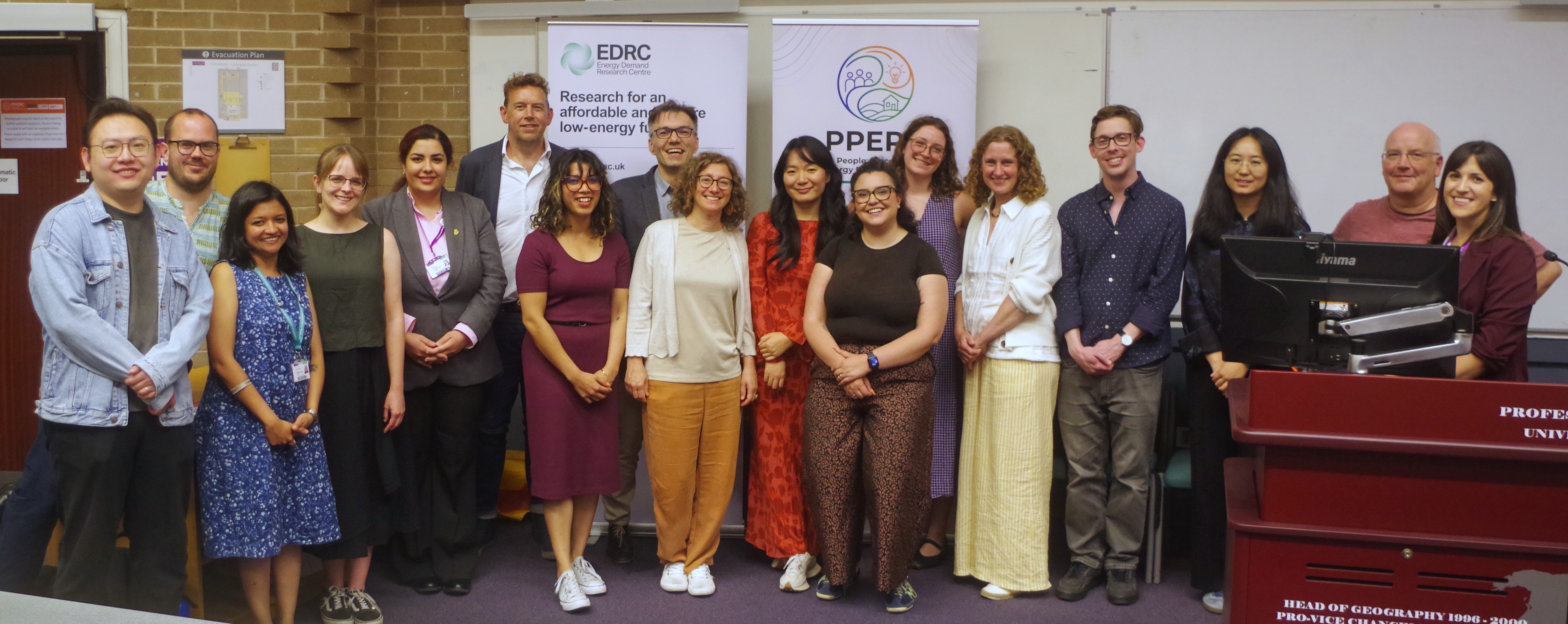
The People, Place and Energy Research Centre (PPERC) brings together University of Manchester researchers who focus on the relationships between people, place and energy. The Centre has strong synergies with, and is supported by, the JUST Centre, also based here in Manchester, as well as the Energy Demand Research Centre.
The Launch event, in collaboration with the School of Environment Education and Development at the University of Manchester, was an opportunity to bring together the interdisciplinary members of PPERC, as well as the wider energy community.
At the launch, Professor Stefan Bouzarovski, PPERC Director, and Dr Katherine Sugar, PPERC Research Co-ordinator, welcomed presenters Nannette Youssef, from the UK’s leading race equality think tank, and Professor Peter Newell, sustainability theme lead at the Sussex School for Progressive Futures.
Stefan also introduced the Centre’s three key research themes:
- Knowing Energy – Led by Professor Hannah Knox
- Digitisation and Energy – Led by Dr Yawei Zhao
- Energy and Participation – Led by Dr Rob Bellamy
Nannette Youssef, Policy Manager at the Runnymede Trust, discussed PPERC’s edited collection, entitled Navigating Persistent Energy and Climate Crises. Collectively, the paper considers the enduring structurally produced multiscalar, multilayered and intersecting infrastructures, governance arrangements, political economies, and social inequalities. These enduring characteristics can worsen crises, rather than alleviating them, shaping access to energy and exposure to risk. Diverse forms of energy injustice, and wider social and environmental injustice are the result, with these vulnerabilities being unevenly distributed.
Energy and climate crises are inseparable from broader systems of marginalisation, they are embedded in gendered, racialised, and classed power relations. Framings come too often from the techno-economic neoliberal approaches whilst marginalising alternative perspectives. Community-level and grassroot interventions are highlighted, and demonstrate the importance of locally embedded action, whilst it is recognised more systemic action is needed to fully address the structural drivers of crises.
In conclusion, Nannette reflected:
“Broadly speaking, the climate and energy emergency are multifaceted and complex issues that requires truly holistic response. It demands that we consider the role of our economic systems, of historical and contemporary debt, the legacies of colonialism and the role of neocolonialism that played into creating and maintaining its impact. Any solution … must tackle its structural causes.”
Peter Newell, Professor of International Relations at the University of Sussex, sustainability theme lead at the Sussex School for Progressive Futures and co-founder of the Rapid Transition Alliance, provided an engaging talk looking at how the world might wean itself off fossil fuels. Whilst this is among the greatest and most difficult challenges the world currently faces, Peter shared emerging findings from a research project exploring the political economy of supply-side policies. These policies seek to leave fossil fuels in the ground through bans, moratoria, restrictions on finance and the like. He went on to discuss national and global attempts to advance these policies and where we might go next in advancing this critical agenda.
In his concluding remarks, Peter notes:
“I think we are seeing these moves … to transition slowly away from fossil fuels, that are gaining momentum, they are being socialised nationally, regionally, increasingly globally. But the uptake clearly is uneven, it’s inconsistent, and it’s highly reversible.”
Watch the full Launch video below:

